1 of 20
Which of the following is the most correct statement based upon imaging:
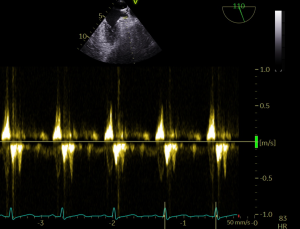
Correct answer option number 1 >> Normal basal LV systolic function
Normokinesia can be defined visually as myocardial systolic thickening ≥50% or systolic excursion > 5mm
2 of 20
A4C cine image is shown below
Findings are consistent with which of the following
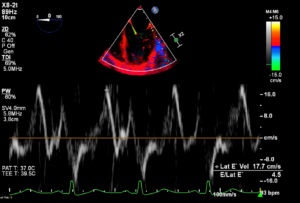
Correct answer option number 3 >> Left atrial mass and preserved LVEF
The right side of the heart is identified by relative positions of the atrioventricular valves (apical displacement of the tricuspid valve relative to the mitral valve)
LV systolic function is visually preserved
3 of 20
PLAX M Mode is shown below. Cursor line is placed through the aortic valve. Findings are consistent with
Correct answer option number 1 >> Normal motion
Aortic valve M mode demonstrates normal cusp motion during diastole (cusp closure and line joining) and systole (cusp opening and line separation)
4 of 20
Severe AR is indicated by which of the following:
Correct answer option number 4 >> EROA 0.31cm²
Mild AR: EROA < 0.1cm²
Moderate AR: EROA 0.1 - 0.3cm²
Severe AR: EROA > 0.3cm²
5 of 20
Calculation of Effective Regurgitant Orifice Area (EROA) by the PISA method is an example of
Correct answer option number 2 >> Law of conservation of mass
The law of conservation of mass states that in a closed system, mass cannot be created or destroyed. The PISA method (also known as the flow convergence method) uses the continuity equation to calculate regurgitant orifice area and is therefore an example of the law of conservation of mass
6 of 20
Aortic regurgitant volume calculation by flow convergence (PISA method) uses which of the following equations:
Correct answer option number 3 >> RV = EROA (aortic valve) x VTI (AR jet)
In contrast, calculation of AR volume by the flow continuity equation (based on the law of conservation of mass) compares stroke volume across the mitral valve and LVOT stroke volume. AR volume = LVOT SV - MV SV
7 of 20
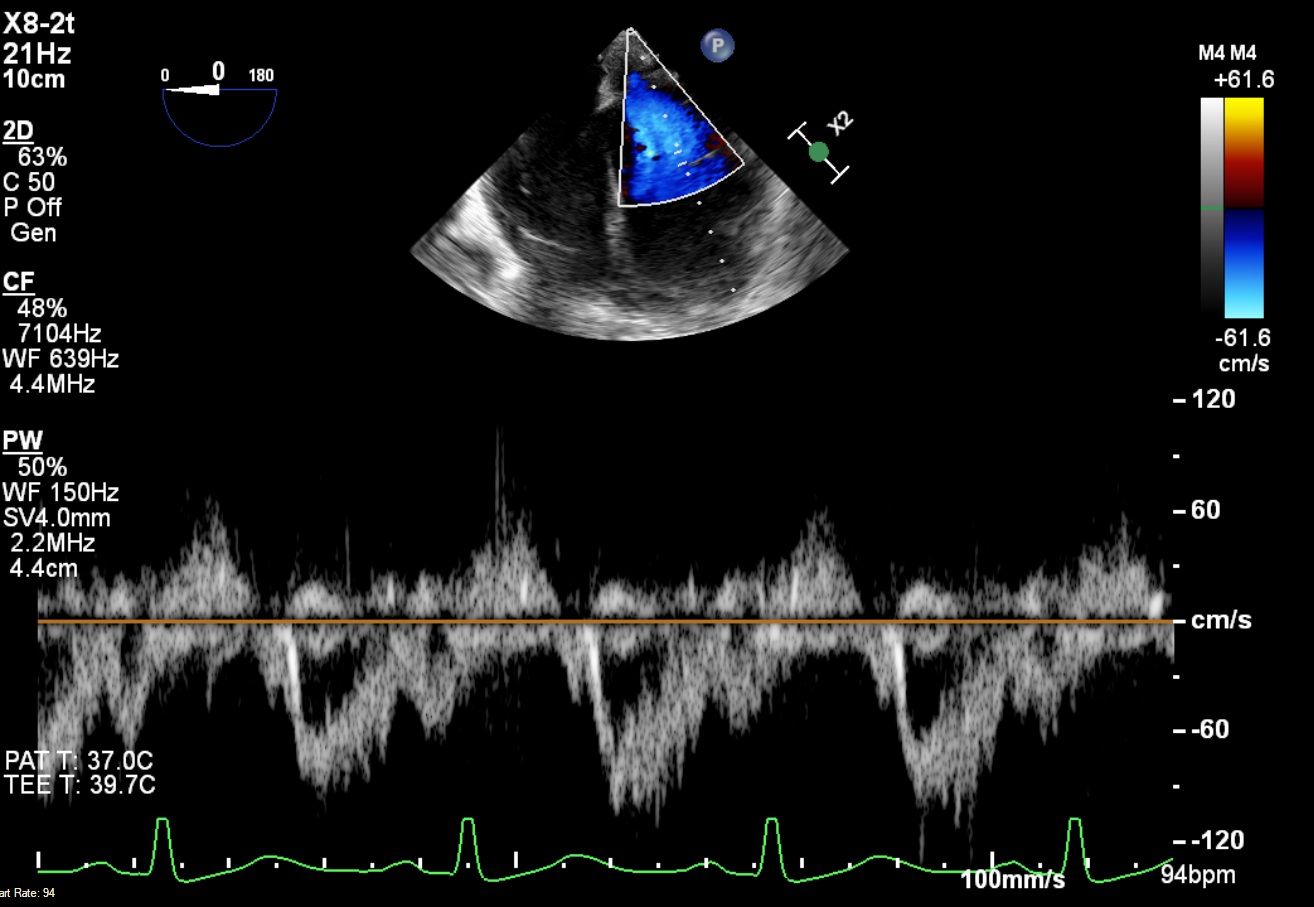
Suprasternal image is shown below. Combined colour Doppler and M mode of flow in the descending aorta is shown. Findings are consistent with
Correct answer option number 1 >> Normal systolic antegrade flow and transient diastolic retrograde flow
Antegrade systolic flow is identified by flow away from the probe (blue on color doppler). Retrograde diastolic flow is identified by flow towards the probe (red on color doppler)
The duration of flow can be estimated using the ECG markings to identify systole (between R wave and middle of T wave) and diastole (from middle of T wave to R wave)
8 of 20
Aortic valve dimensionless index is defined by which of the following
Correct answer option number 1 >> Vmax LVOT / Vmax Aortic Valve
There are two formulae for Dimensionless Index (DI):
1. DI = LVOT VTI / Aortic valve VTI
2. DI = LVOT Vmax / Aortic valve Vmax
DI 0.25 - 0.5 is suggestive of moderate AS
DI < 0.25 is suggestive of severe AS
9 of 20
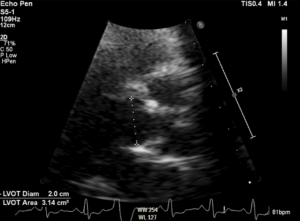
Incorrect measurement of LVOT diameter resulting in underestimated LVOT diameter will have which effect on subsequent estimation of AS severity
Correct answer option number 2 >> Overestimate AS severity
This is a common error due to:
1. Often elliptical shape of the LVOT rather than circular
2. Measurement of anteroposterior LVOT diameter in parasternal long axis while the largest diameter may be in fact be lateral
Underestimation of LVOT diameter results in underestimation of AVA (aortic valve area) and therefore overestimation of AS severity
10 of 20
Estimation of mitral regurgitation severity is affected by severe aortic stenosis in which way
Correct answer option number 2 >> Overestimation of MR severity
Severe AS overestimates MR severity due to elevation of left ventricular pressure with resultant increase in transmitral pressure gradient and appearance of larger MR jet on color doppler
11 of 20
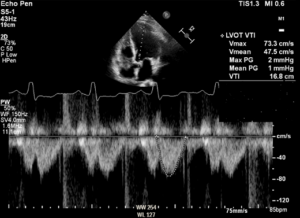
Echo data are shown below. If LVEF is 35% and BSA (body surface area) is 1.8m², findings are consistent with which of the following:
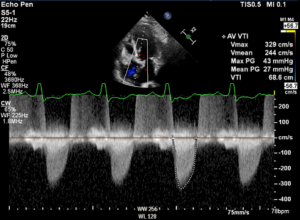
Correct answer option number 1 >> Classic low flow low gradient aortic stenosis
LVEF is moderately impaired (35%) and Stroke Volume index (SVi) is impaired (29.3mls/m²)
Classic LFLG AS is associated with impaired LVEF and SVi
In contrast paradoxical LFLG AS is associated with preserved LVEF and impaired SVi
LVOT SV = LVOT cross sectional area (πr²) x LVOT VTI and LVOT SVi = LVOT SV / BSA
Therefore LVOT SV = π1² x 16.8
LVOT SV = 52.67 mls
LVOT SVi = 52.67 / 1.8 = 29.3mls/m²
12 of 20
Which mitral valve scallops are visible in A2C
Correct answer option number 2 >> P1A2P3
Mitral valve scallops visible on apical and parasternal views are as follows:
Apical 2 chamber (A2C) : P1A2P3
Apical 3 chamber (A3C): A2P2
Apical 4 chamber (A4C): P1A2A3
Parasternal long axis (PLAX): A2P2
Parasternal short axis (PSAX): All scallops
13 of 20
Waveform from CW Doppler interrogation of mitral valve inflow is shown below. Findings are consistent with which of the following
Correct answer option number 3 >> MVA 1.2cm²
Calculation of Mitral Valve Area (MVA) by Pressure Half Time (PHT) method is given by the following formula:
MVA = 220 / PHT
The doppler waveform demonstrated here is biphasic which can suggest atrial fibrillation or severe MS
By convention the slope is traced from the peak of the waveform and does not include the second peak
14 of 20
HCM -SCD (Hypertrophic Cardiomyopathy – Sudden Cardiac Death) risk scores are used to calculate SCD risk in HCM patients. Which of the following echo parameters are used as part of the scoring system:
Correct answer option number 3 >> Left atrial diameter on PLAX
HCM-SCD risk score calculators use the following datapoints:
1. Age at time of evaluation
2. Family history of SCD
3. Max ventricular wall thickness
4. Left atrial diameter in PLAX
5. Maximum LVOT gradient
6. Non sustained or Sustained VT
7. Unexplained syncope
15 of 20
Restrictive cardiomyopathy and Constrictive pericarditis may be distinguished based on the following:
Correct answer option number 3 >> Elevated E/E’ in restrictive cardiomyopathy and normal E/E’ in constrictive pericarditis
Restrictive cardiomyopathy (RCM) and constrictive pericarditis (CP) are distinguished by the following echo parameters:
16 of 20
PW Doppler interrogation of mitral valve inflow is shown below. E/A ratio is consistent with which grade(s) of diastolic dysfunction:
Correct answer option number 4 >> Grade III or IV diastolic dysfunction
Grade 0 diastolic dysfunction: E/A ratio typically 1-2
Grade I diastolic dysfunction: E/A ratio reduced, typically < 1
Grade II diastolic dysfunction: E/A ratio pseudonormalised, typically 1-2
Grade III diastolic dysfunction: E/A ratio increased, > 2
Grade IV diastolic dysfunction: E/A ratio increased, > 2
17 of 20
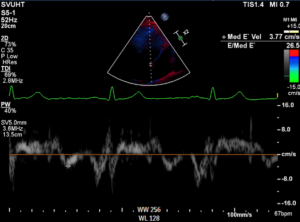
Mitral inflow and mitral TDI data are shown below
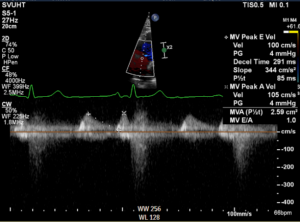
Findings are suggestive of:
Correct answer option number 3 >> Grade II diastolic dysfunction
Grade 0 diastolic dysfunction (normal diastolic function):
E/A ratio normal, typically 1-2
Septal E' (also known as Septal e) > 8 cm/s
Septal E/e < 10
Grade I diastolic dysfunction:
E/A ratio reduced, typically < 1
Septal E' (also known as Septal e) < 8 cm/s
Septal E/e < 10
Grade II diastolic dysfunction:
E/A ratio pseudonormalised, typically 1-2
Septal E' (also known as Septal e) < 8 cm / s
Septal E/e > 10
Grade III diastolic dysfunction:
E/A ratio increased, > 2
Septal E' (also known as Septal e) < 8 cm/s
Septal E/e > 10
Grade IV diastolic dysfunction:
E/A ratio increased, > 2
Septal E' (also known as Septal e)
Septal E/e > 10
18 of 20
PW Doppler interrogation of pulmonary venous flow is shown below. Assuming duration of mitral inflow A wave (Adur) is 105msec, findings are suggestive of
Correct answer option number 3 >> Diastolic dysfunction
This waveform demonstrates diastolic dysfunction. Overall the data are suggestive of grade II diastolic dysfunction
19 of 20
Echo sweep speed for assessment of respiratory variation in mitral and tricuspid valve inflow is best described by
Correct answer option number 2 >> Decreasing sweep speed to 25 mm/s
Respiratory variation requires visualization of a greater number of inflow waveforms to assess for changes during inspiration and expiration.
Decreasing sweep speed increases the number of visible waveforms and thus allows accurate assessment for variation of flow over a greater time period
20 of 20
Aortic valve morphology in PSAX aortic valve level is shown below
Findings are consistent with which of the following
Correct answer option number 2 >> Bicuspid aortic valve
Bicuspid aortic valve is demonstrated with approximately horizontal commissural line (anterior / posterior orientation)
Bicuspid aortic valve occurs in 1-2% of the general population. Bicuspid aortic valve morphology is classified by the Sievers classification